
Myopia Management & Specialized Control Lenses
Childhood myopia, commonly called nearsightedness, causes distant objects to appear blurry and may worsen as a child grows. While traditional nearsighted glasses correct blurry distance vision, they do not necessarily address the excessive eye growth associated with progressive myopia.
At Lumen Eye, we offer personalized myopia management options designed to proactively manage myopia and support your child’s long-term eye health. Our approach combines specialized lenses, careful monitoring, and ongoing guidance based on each child’s prescription, lifestyle, and visual development.


Why Proactive Myopia Control Is Important
Myopia often progresses during childhood as the eye grows longer from front to back. This causes light to focus in front of the retina instead of directly on it, resulting in blurry distance vision.
Standard prescription glasses improve clarity, but most conventional lenses do not slow the underlying growth of the eye. Myopia control uses specialized optical treatments designed to reduce the visual signals associated with progression.
Slowing myopia may help reduce the prescription a child carries into adulthood. This is important because higher levels of myopia are associated with an increased lifetime risk of retinal detachment, glaucoma, cataracts, and myopic macular degeneration.
Beginning care while myopia is still mild may provide more opportunities to limit progression. A kids eye exam allows our eye doctors to evaluate your child’s vision, establish baseline measurements, and recommend an appropriate treatment plan.
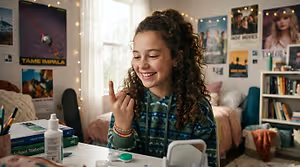
Advanced Myopia Lenses at Lumen Eye
Our eye doctors consider your child’s age, prescription, eye health, daily activities, and comfort before recommending treatment. Available myopia lenses may include overnight Ortho-K lenses, soft multifocal contacts, or specialized glasses.
Orthokeratology (Ortho-K) Lenses
Orthokeratology uses custom rigid gas-permeable contact lenses worn overnight. While your child sleeps, the lenses gently reshape the cornea, which is the clear front surface of the eye.
After removing the lenses in the morning, many children can see clearly throughout the day without nearsighted glasses or daytime contact lenses. Ortho-K also creates an optical effect designed to help slow myopia progression.
An orthokeratology screening allows our eye doctors to assess the shape and health of your child’s corneas, review their prescription, and determine whether overnight lenses may be suitable. Ortho-K requires professional fitting, careful hygiene, and regular follow-up care.
Be Free® Day Contact Lenses
Be Free® Day lenses are silicone hydrogel daily disposable contacts developed to support myopia care. Their soft, breathable material allows oxygen to reach the cornea while providing the convenience of a new lens each day.
The lenses use a multistep optical design intended to maintain clear central vision while creating peripheral myopic defocus. This treatment effect is designed to help manage the visual signals associated with continued eye growth.
Be Free lenses may provide another soft multifocal option for children who prefer daytime contacts over glasses or overnight lenses. Our team will assess your child’s prescription and visual needs before recommending these or other specialty contact lenses.
Specialized Myopia Glasses
Specialized myopia glasses provide clear central vision while using carefully designed peripheral defocus zones to help reduce the stimulus for excessive eye growth.
These lenses may be appropriate for children who are not ready to wear contact lenses or prefer the familiarity of glasses. They are worn like conventional nearsighted glasses, making them easy to incorporate into school, home, and family routines.
Our team can explain how myopia-control spectacle lenses differ from standard single-vision lenses and whether products such as Stellest® lenses may be suitable for your child.

What to Expect During a Myopia Consultation
Comprehensive Kids Eye Exam
A kids eye exam establishes a baseline for visual acuity, prescription, focusing ability, eye coordination, and overall eye health. We also review your child’s family history, visual habits, and previous prescription changes.
Personalized Lens Selection
If specialty contact lenses are recommended, we evaluate the shape and health of your child’s eyes before selecting Ortho-K, MiSight, Be Free, or another design. We also provide guidance on safe lens insertion, removal, handling, and hygiene.
Children who prefer glasses may be evaluated for specialized myopia-control spectacle lenses. The recommended option will depend on your child’s prescription, treatment goals, and daily routine.
Ongoing Monitoring
Regular follow-up visits help us track prescription changes and assess how your child is responding to treatment. When appropriate, we may measure axial length, which is the distance from the front to the back of the eye, to monitor growth more precisely.
Treatment recommendations may be adjusted as your child grows or their visual needs change.
Myopia Management FAQs
When Should a Child Begin Myopia Control?
Myopia control is often most effective when it begins early, while a child’s eyes are still actively growing. The right time to start depends on their age, prescription, rate of progression, family history, and overall eye health.
Children who squint, sit close to the television, struggle to see the classroom board, or experience frequent prescription changes should receive a comprehensive kids eye exam.
Is Orthokeratology Safe for Children?
Ortho-K can be a safe, nonsurgical option when the lenses are professionally fitted and children follow proper cleaning, handling, and wearing instructions. Regular follow-up visits are essential for checking the lens fit and maintaining corneal health.
Children should not swim while wearing Ortho-K lenses. However, because the lenses are removed in the morning, they may participate in daytime activities without relying on glasses or contacts when their vision remains clear.
Are Soft Multifocal Contact Lenses Comfortable?
MiSight and Be Free lenses are soft daily disposable contacts designed for daytime use. Many children adapt well to them, although comfort and vision vary from person to person.
A personalized fitting and regular follow-up care help ensure the selected specialty contact lenses continue to provide appropriate vision, comfort, and eye health.

Proactively Manage Your Child’s Myopia
Progressive myopia involves more than an increasing glasses prescription. Early evaluation and personalized myopia management can help slow eye growth, support clear vision, and reduce the likelihood of developing high myopia.
Schedule a consultation at Lumen Eye to learn whether Ortho-K, MiSight, Be Free, or specialized myopia glasses may be right for your child.