
Macular Degeneration Care in Urbandale, IA
Age-related macular degeneration (AMD) affects the part of your retina responsible for the detailed central vision you use to read, drive, recognize faces, and complete everyday tasks. Because AMD can develop without noticeable symptoms at first, regular eye exams play an important role in finding changes early.
At Lumen Eye, we use detailed eye health evaluations and modern diagnostic technology to identify and monitor changes in the macula. If treatment from a retinal specialist becomes necessary, we can help you understand the findings and coordinate the next steps in your care.


What Is Macular Degeneration?
The macula is a small area near the center of the retina, the light-sensitive tissue at the back of your eye. It provides the sharp, straight-ahead vision needed to see fine details.
Age-related macular degeneration occurs when the macula becomes damaged over time. AMD does not typically cause complete blindness because peripheral vision usually remains intact, but advanced disease can significantly affect central vision and make everyday activities more difficult.
Symptoms may include:
Blurry or distorted central vision
Straight lines appearing wavy
Dark or blank areas in the center of your sight
Difficulty recognizing faces
Reduced brightness or intensity of colors
Greater difficulty seeing in dim lighting
Straight lines suddenly appearing wavy can be a warning sign of advanced AMD and should be evaluated promptly.
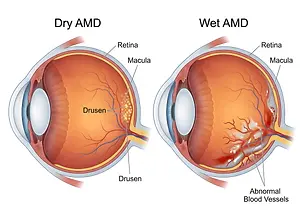
Dry vs. Wet Macular Degeneration
Dry Macular Degeneration
Dry AMD is the more common form. It develops as the macula gradually thins with age and small deposits called drusen accumulate beneath the retina. Progression is often slow and may occur over several years.
Dry AMD can progress through early, intermediate, and advanced stages. In advanced dry AMD, areas of retinal cells may deteriorate in a process called geographic atrophy, resulting in central vision loss.
Wet Macular Degeneration
Wet AMD is less common but can cause vision loss much more quickly. It develops when abnormal blood vessels grow beneath the retina and leak blood or fluid into the macula.
Wet AMD is considered a late stage of the disease. Because changes can happen quickly, new distortion, blurred central vision, or blank areas should be examined without delay.
How Is Macular Degeneration Treated?
Treatment depends on the type and stage of AMD. While existing vision loss cannot always be reversed, current treatments can help slow progression or reduce the risk of additional vision loss.
Treatment for Dry AMD
- Early dry AMD is usually monitored with regular eye exams and healthy lifestyle habits. AREDS2 supplements have not been shown to benefit early AMD, but they may be recommended if your condition progresses.
- For people with intermediate AMD, or advanced AMD affecting one eye, a specific combination of vitamins and minerals known as AREDS2 supplements may help reduce the risk of progression to advanced disease. These supplements are not appropriate for every patient, so they should be discussed with your eye care provider rather than started automatically.
Treatment options are also now available for some patients with geographic atrophy caused by advanced dry AMD. FDA-approved medications including Syfovre® (pegcetacoplan) and Izervay™ (avacincaptad pegol) are injected into the eye by a retinal specialist and can slow the progression of geographic atrophy. They do not restore vision that has already been lost, and their potential benefits and risks require careful discussion with a specialist.

Treatment for Wet AMD
- The primary treatment for wet AMD is anti-VEGF medication. These medicines are injected into the eye by a retinal specialist and work by blocking signals that encourage abnormal blood vessels to grow and leak.
- Anti-VEGF treatment can slow or stop additional vision loss, and some patients experience improved vision. Several medications are available, and treatment frequency depends on how the eye responds.
Photodynamic therapy may also be used in selected cases, although it is much less common than anti-VEGF treatment and may be combined with injections.
Monitoring Your Macular Health at Lumen Eye
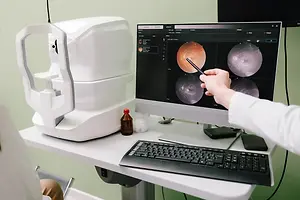
AMD care begins with knowing what is happening inside your eyes. A comprehensive dilated eye examination allows us to assess the retina for changes associated with macular degeneration. Imaging such as optical coherence tomography (OCT) can provide detailed views of retinal structures and help track changes over time.
If we identify signs that require treatment from a retinal specialist, we’ll explain what we see and help coordinate appropriate care. We can also continue monitoring your overall eye health alongside your specialist treatment.

Protect Your Central Vision
Macular degeneration can progress quietly, so waiting for your vision to change is not the best way to protect your sight.
If you have been diagnosed with AMD, have a family history of the condition, or have noticed changes in your central vision, schedule an eye exam at Lumen Eye. We’ll give you clear answers about your eye health and help you understand what should come next.